
“Many of us in the LGBTQ+ community learned who we were while others were telling us who to be.”
In honor of LGBTQ+ History Month, we're spending October exploring a spiritual practice that so many of our LGBTQ+ siblings of faith engaged with for centuries: pilgrimage. Over the last few weeks, we shared stories from LGBTQ+ Christians who have encountered God through pilgrimage in all kinds of ways.
Although we cannot share stories highlighting every kind of pilgrimage, identity, or experience in just a few short weeks, we are excited to share these stories with you this season and hope to share more in the future as we hear of your stories of pilgrimage.
Today, Q Christian Fellowship’s Communications Director, Aiden Nathaniel Diaz, reflects on leading a group of twelve United Methodist clergy and laity on a Civil Rights Pilgrimage of Michigan last March.
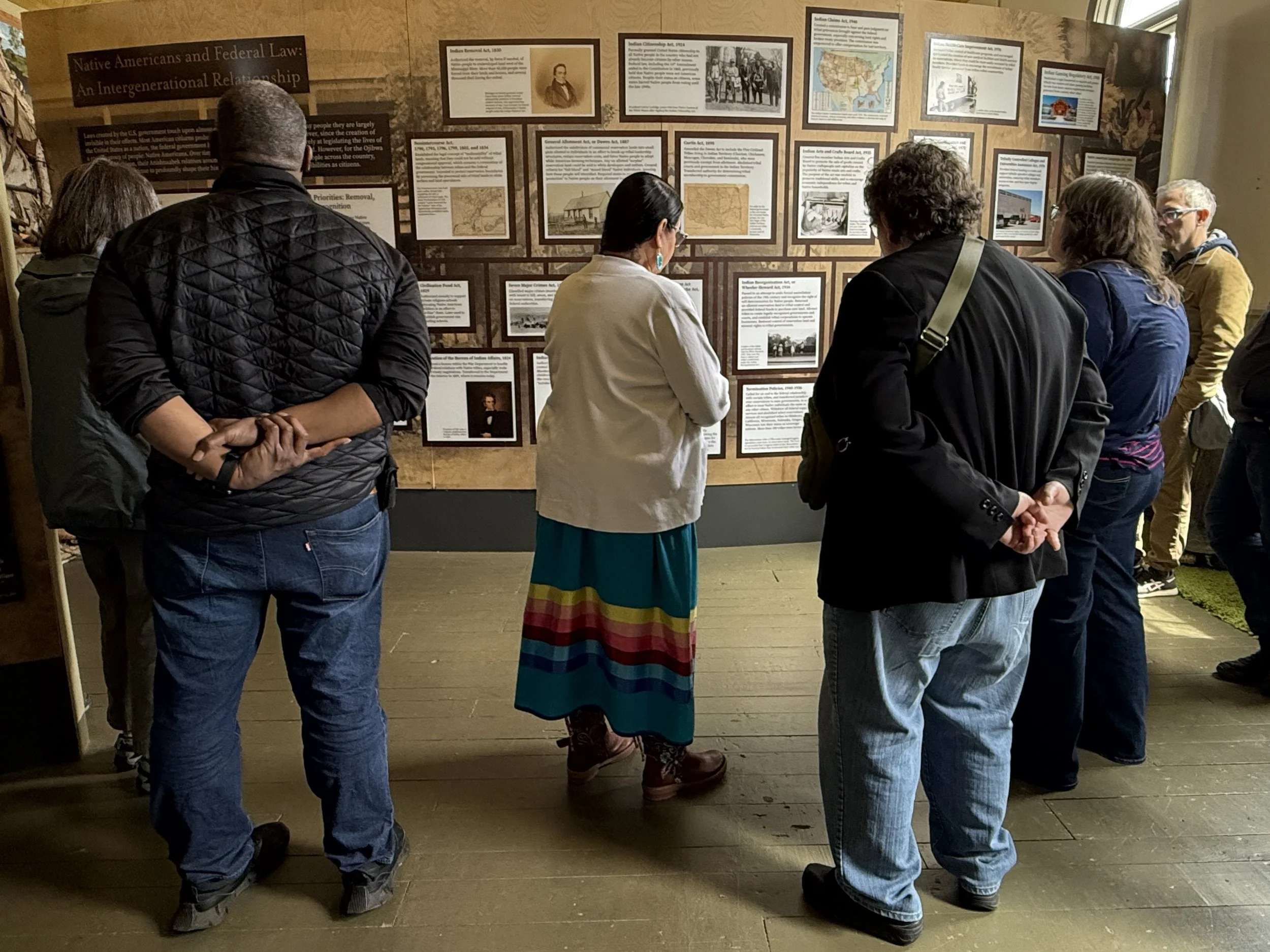
Pilgrims learning the history of Indigenous communities in the Upper Peninsula in Michigan.
In February 2025, I was approached by leadership of the Michigan Conference of the United Methodist Church to consider being a part of a team of laity and clergy to plan a Civil Rights Pilgrimage. I was no stranger to pilgrimage; I had already walked the Camino de Santiago, visited the Holy Land, and engaged with a local pilgrimage between my seminary chapel and the Texas Capitol. However, as someone who had recently moved to Michigan after living in Texas most of my life, I was not sure if I felt equipped to lead this group. What I learned is that I did not need to be an expert. I needed to be a listener.
At that first planning meeting, we considered what a Civil Rights Pilgrimage could look like for our context. We left that meeting with a clear vision: instead of traveling to the South to study the civil rights era, we would travel to the corners of our state and hear the struggles that shaped the communities we live in.
A year later, twelve of us crammed into a church van and a little sedan and drove between seven towns. We heard the stories of Indigenous communities in the Upper Peninsula, stories of LGBTQ+ safe spaces along Lake Michigan, stories from immigrants who were seeking safety, stories of Black Americans who made their way to Detroit for countless opportunities, stories from Arab Americans who shaped American culture, and stories from officials of the City of Flint who shed new light on the water crisis. We met with nonprofit organizations who were bridging the gap between deep history and helping people find the support they need today. At night, we gathered, reflected, and spent time with God as we discerned what the learnings of the day meant for each of the communities we serve. As an LGBTQ+ Christian, I listened to each of these stories knowing what it is like to wait for others to hear yours.
Somewhere between the van rides and the evening reflections, I kept hearing what my mother had shared with me 20 years prior after I asked her why she kept watching news channels she disagreed with: You cannot love your neighbor if you do not know your neighbor.
She quoted Mark 12:29-31:
Jesus answered, “The first is, ‘Hear, O Israel: the Lord our God, the Lord is one; you shall love the Lord your God with all your heart and with all your soul and with all your mind and with all your strength.’ The second is this, ‘You shall love your neighbor as yourself.’ There is no other commandment greater than these.”
Then my mother said, “If you do not know God and who God is, then you cannot love God. If you do not know who your neighbor is, you cannot love your neighbor. If you do not know who you are, you cannot love yourself and thus cannot love your neighbor well either.” For her, knowing her neighbor meant knowing what affected those around her even when she did not agree with them. It went deeper than knowing their name and saying hello as one passed by, but knowing what mattered to them and knowing what made them feel seen.
The part of her lesson that stays with me most is the middle one: if you do not know who you are, you cannot love yourself. Many of us in the LGBTQ+ community learned who we were while others were telling us who to be. Knowing yourself is not a given. For many of us, it is hard-won, and it is a spiritual act. On this pilgrimage, I watched people tell the truth of their histories, often at a cost, and I realized that being known by our neighbors begins with having the courage to know ourselves.
I also want to be honest that this is not easy. Many of us have been asked to understand people who do not try to understand us. Knowing your neighbor does not mean excusing harm or staying silent about it. It means being willing to listen for what shaped them and what they have endured, while still telling the truth about what has been done to you and to others.
May you sit with the stories your town would rather forget. May you find ways to bridge the history of your town with caring for your neighbor. May you find ways to be a pilgrim in your own communities, searching for God in the everyday spaces and faces you see.
Q Christian Fellowship aims to prophetically model a world where all LGBTQ+ people are fully loved by family, church, and community, and Christians worldwide live up to their calling to be instruments of grace and defenders of the outcasts. The generosity of those who believe in this work is crucial to that vision. If you'd like to help us to continue to create resources and spaces where faith and identity are held together, we invite you to make a donation at the link below!